Showing posts with label Pikemans Lament. Show all posts

Wednesday, 19 July 2023

GNW - 2 more games

Tuesday night is games night. After last weeks games at Oldmeldrum Wargames Club, we decided we'd have another game or two this week. As I'd finished painting and basing cavalry to go with my infantry I thought we'd have a cavalry only game - and so played the River Crossing Scenario from the Pikeman's Lament rulebooks. The Swedes had two units of Gallopers plus two units of Cossacks, which the Russians had Trotters and two Cossacks. The Russians should really have been dragoons but I wanted to see how the two different cavalry units would interact. 

The Russians sent their Cossacks galloping forward and across the central bridge whilst their horse aimed for either flank. The Swedes on the other hand sent the majority of their mounted men to the western side of the bridge, only to have to pull some back as the Russian Cossacks crossed swiftly. A swirling skirmish broke out with units circling and trying to wipe each other out, in the end the Swedes came off best and the surviving Russian Cossacks retreated off table.


However on the river itself things were interesting the caracoling Russian horse nibbled away at their Swedish opponents, wearing them down. Seeing no other option the Swedish leader challenged his Russian opponent to a duel which he won with a thrust of his sword. However poor activation dice on the Swedish part game the Russians a chance to retaliate and they overran the Swedish unit "capturing" said officer and leading him to the rear where his chances looked slim!

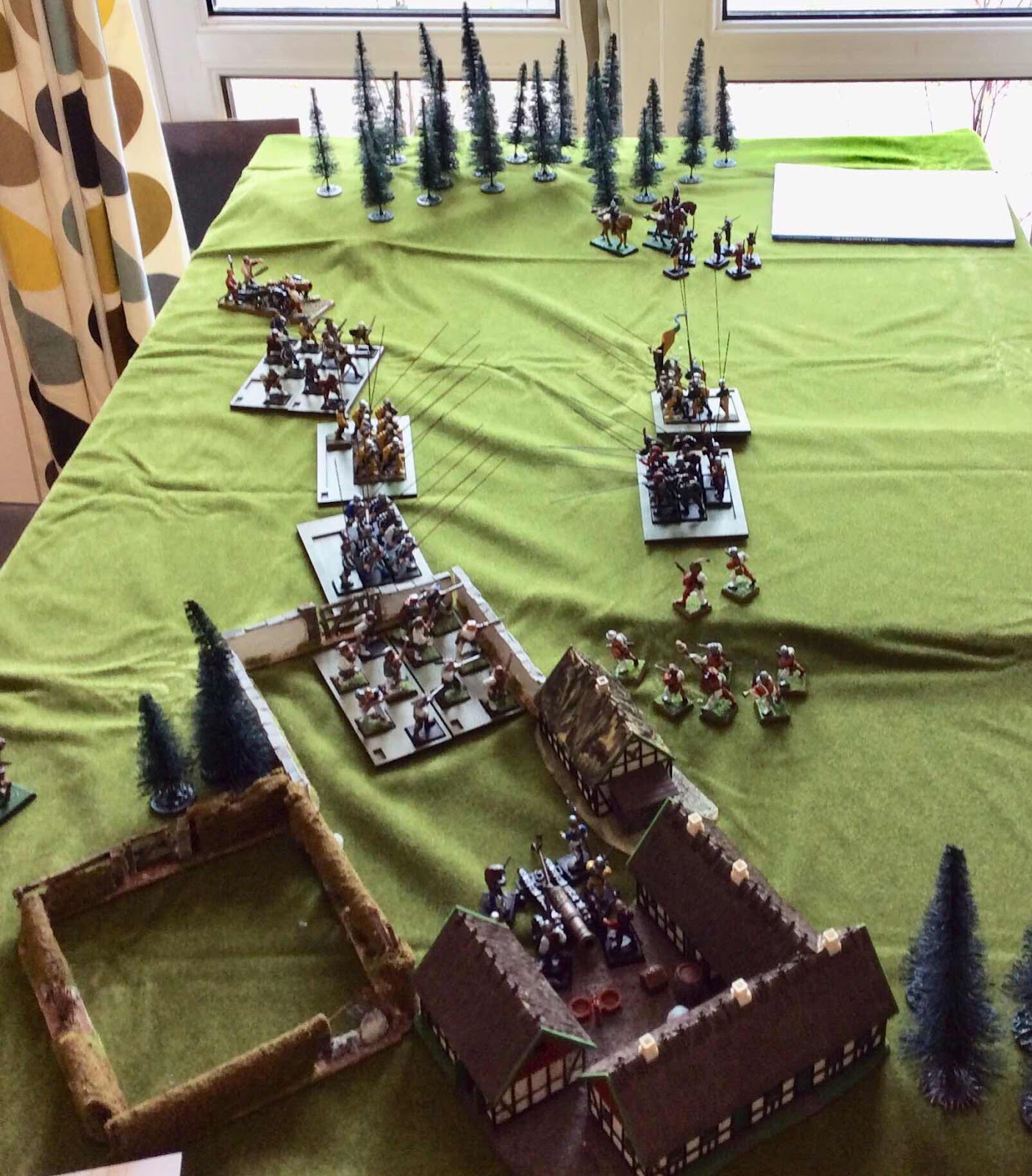
Leaderless and without the ability to drive away the Swedes the game was over for the Russians but we decided to play a second game. The Swedes would deploy their infantry up to the line of the river. The Russians would deploy theirs along the north edge of the table. The Swedes went first placing a field gun on the south east corner to fire along the Russian line and a veteran musketeer unit between the gun and the bridge, a unit on the bridge and a unit of horse and final musketeer unit on the north western length of the river. The Russians lined up along the table but stacked their forces on the right, they also deployed a gun, a lighter and mobile battalion piece. 

Driving forward the Russians were soon at the river and splashed across wearing down the Swedish units with good musketry and the supporting battalion gun. The swedes put in a cavalry charge but it was easily seen off and after several poor activation rolls and a blunder their flank was swept away. The Russians managed to lose a unit in trying to attach the bridge, but regained it when they score well following a double 6 allowing them to gain a 4pt reinforcement. As the Russians had now cleared the Swedish flank their position was untenable and the game was called. 


Two great games, very different, but fought over the same terrain. I think we'd do the same again, playing out different phases of scouting, approach and pitched battle. The all cavalry game was fun - first time I think I've had a game without any supporting foot. 

Next week we're going to take a look at using the Pax Baltica board game to give us a campaign and link it somehow with tabletop games.

Wednesday, 12 July 2023

GNW Game - Baggage Train

 Since I had finished my GNW Swedes and Cossacks it was time to put them on the table for a game. 

On Tuesday evening I ran the King's Warchest scenario from the Pikeman's Lament rules by Osprey at Oldmeldrum. 


In the scenario a group of wagons has been left somewhat unattended while their guards are at the edge of a lake or river. The attacker, the Russians in this instance, see an opportunity and pounce, hoping to snatch the wagons. 

In our game the Russians couldn't quite press their attack and get men close enough to steal a wagon and suffered the loss of both of their flanks as supporting Swedish troops arrived to thwart their efforts. 


As it was only 9 o'clock we decided to play a straight across table fight. This time the Russians came out on top, destroying the Swedish left although the Swedes achieved some honour by forcing the Russian Cossacks to rout. 


Two good games. The ebb and flow of battle is really well represented by the flip of initiative from side to side when an activation test or rally test is failed. It can be frustrating to lose at the beginning of your turn, but in these small games there's no long wait til it's back to you and an option for multi player games would be for each player to have an officer and a separate turn. 

It's was good to see the figures on the table too - nice bright colours, soon to be augmented by regular cavalry for both sides when I get round to finishing the bases for them too. 

Monday, 30 May 2022

Feud - Wargaming the Gordon - Forbes Feud and Marian Civil War 1562-1571

I hosted my mates John and Eric from Banchory today and so we decided to game the Battle of Corrichie once more. John and I first discussed fighting this battle many many years ago. John reminded me that it was when Grampian Battles by Peter Marren, was reprinted, which would be around 20years ago!

Having played it before using Pikeman's Lament I set the kitchen table up to represent the Hill o' Fare above Garlogie and Raemoir. The rules can make a battle swing either way with their initiative mechanism and the first game was no exception. 


The battle got off to a start with the Gordon foot charging into Errol's horse and coming off the worse for it, routing back into the rough ground to the rear with Huntly himself becoming separated and hiding in the bog. However Bissets foot now saw them off and and pushed forward towards the raw Aberdeen foot. These too were seen off but the rebels were now in a poor shape. Moray's foot came up and a desperate charge was launched by the Irvines, in an attempt to force their way clear and get home to Drum castle. Moray was wounded but saved by his men and Irvine's unit was broken. 

Game over and a pause for lunch to reflect. 

As this was a refight and not a balanced scenario the odds were stacked against Huntly's men. Even so , they were able to inflict losses and drive back the Aberdeen men. They were just too worn to make an impact on the well drilled Lothian troops. Losing Huntly and his unit so early also reduced the rebels chances of winning.

After lunch we gave Neil Thomas's One Hour Wargames a go. A very simple but well thought out set with limited unit types. We refought Corrichie and then had a larger across table game with randomly diced for units. Corrichie, using only three units a side was really too small but the second game was more interesting and looked and felt like a decent battle. These rules are worth a revisit sometime soon. I have some landsknechts languishing in a box and these would be perfect for a fun afternoon. 
Round two at Corrichie

Third Game


 Corrichie, Tillyangus, Corgarff and Craibstane are battles which will feature in my next book. They're all small encounters perfect for Pikeman's Lament. 

I've sold a few of my books from my last post .- but there are still bargains to be had and of course both Sugar Islands and Against Spain are still available too. 

Tuesday, 20 April 2021

Another Jacobite Fight

This time a straight across the table fight featuring 6 Jacobite clan unit's and a small unit of Royal Ecossais against 3 Hanoverian line and two grenadier units. 


A scrappy engagement with lots of fluffed initiative rolls and swapping back and forth between the two sides without either side getting a change to get the upper hand. It did however stop the jacobites for getting a couple of telling charges in and caused them to take some more losses. But they rallied and drove the redcoats back to the table edge, despite them getting reinforcements in the shape of a fresh unit. In the end though weight of numbers began to tell and the remaining redcoats sued for peace after suffering the loss of a further unit. 

The Jacobites didn't get their own way tonight and a few times were kept off by the shooting and bayonet drill of the government troops. But they in turn couldn't quite fend off all the clan units and their perimeter shrunk and shrunk until they had nowhere left to go.

This was the second of our club Jacobite battles. We plan a third next week. Stay tuned! 


Wednesday, 14 April 2021

A Jacobite Game

 It's the 275th anniversary Culloden on the 16th and now that I have care of some jacobites I organised an online zoom game with mates from Oldmeldrum Wargames Club. 

Scenario notes and background were issued to the players before hand and the game itself was based on Prestonpans. A slight comms hiccup meant the Hanoverian commander didn't get orders back in time and one of his colleagues had the men deploy facing Edinburgh rather than the Jacobites who had listened to advice, looked at at the map and decided to march round the back of the redcoats. 

The battle was confusing, bloody and broke down into individual scraps and firefights. The melee capabilities of the clansmen were ferocious and the raw redcoats suffered from being wrong footed, struggling to turn and prepare and being poor shots. Not all went for the Jacobites - they lost control over their men once the clans got close enough to charge and at times fluffed activation rolls and had units retire whilst the action was still in full swing. However it went badly for the Hanoverians and they couldn't get organised to get their raw troops from causing anything other than minor damage to the highlanders. Their formation broke up and around half were cut down or fled by the games end.

A historical result and nice getting some toys on the tabletop


Sunday, 24 May 2020

16thC Distraction - Huntly and Family

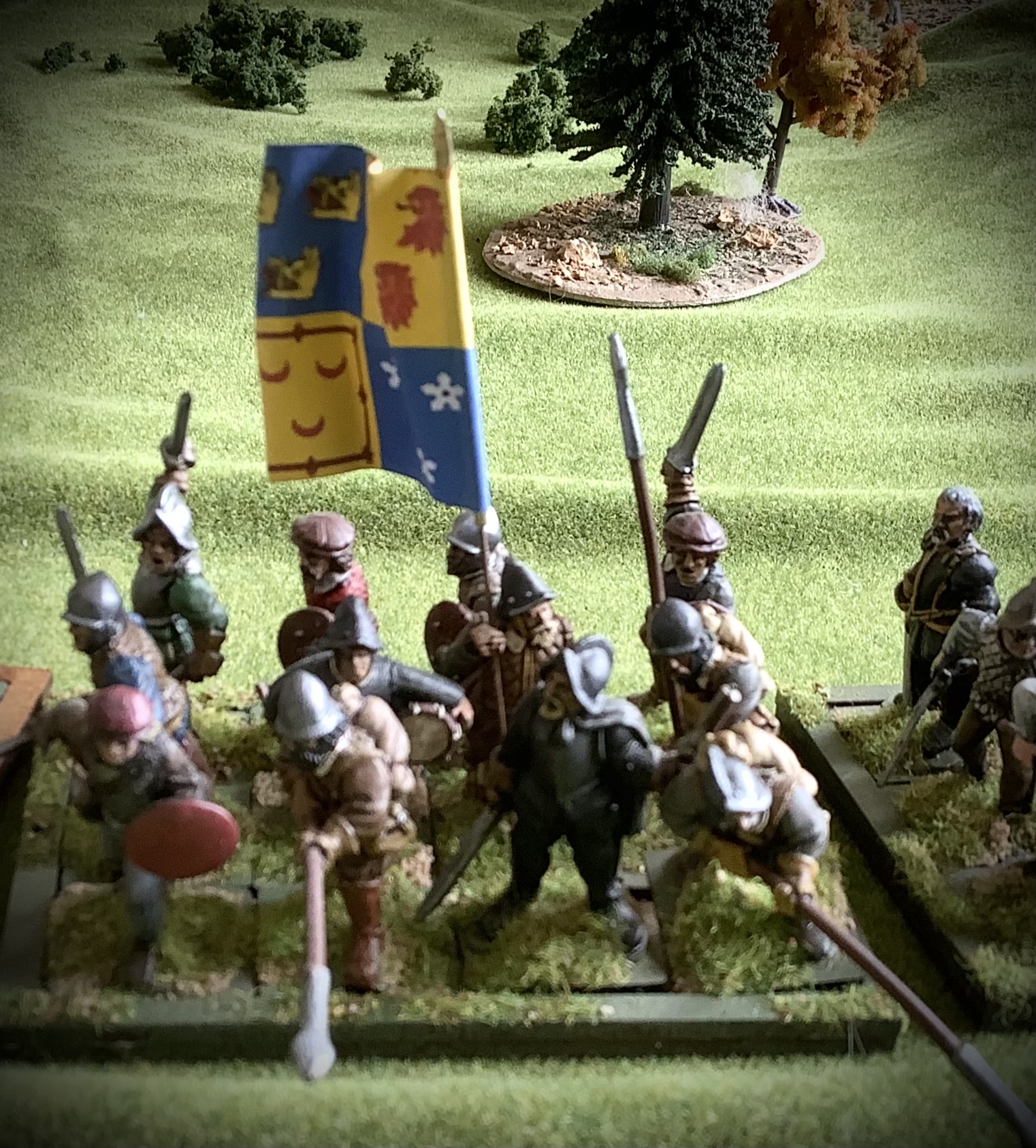
I received my Border Reiver figures from Timeline/Hoka Hey. These are the ex Graven images Jim Bowen range and are a chunky but wonderfully sculpted and were a pleasure to paint. They're not the cheapest, but neither are Foundry for example and sometimes you pay for what you get. I'd certainly buy more of these.

I have painted them up to represent the Gordon Family. 
The Earl of Huntly is described as being overweight and older. He died of a stroke or heart attack immediately after the battle. I tried to give him a flushed skin tone, but am not sure if that came out. He is dressed in expensive black clothing and wears a gilded breastplate. He is bareheaded, so his men and his foes know him, and perhaps so he can breath a bit better!
His son John, flanks him in his morion and black clothing, he is armed with a pistol and sword.  He is in a world of trouble and probably knows that whatever happens to his father he is most definitely in for the full wrath of the Queen and Regent and has nothing to lose.
Huntly's youngest son, Adam, is also a hothead, like his brother John. Songs will be written about the terrible Edom O' Gordon and his deeds, but he will survive and become a faithful servant of James VI. 


Around around them are other members of the Gordon household and they will be fighting under Huntly's banner.

I now have enough figures painted to refight the battle. Some basing needs done. I purchased some movement trays but due to a tolerance problem of base size to slot size these needed to be modified and sanded out. Not a problem I've had before. I will be going back to my normal supplier Warbases and ordering some custom bases when they reopen, I've never had problems with those. What I'd really like is some irregular shaped bases that are textured with a slot. I've yet to see such things, but if anyone knows of them, let me know. 

Tuesday, 19 May 2020

16thC Distraction - Huntly's men

Huntly's Men.

The Earl of Huntly was the preeminent nobleman in North East Scotland. He controlled or had influence over most of what is now Aberdeenshire, parts of Moray and Badenoch. Until however his family began to fall from favour. 

At Corrichie, Huntly led between 500-800 men. Some were drawn from his family heartlands around Strathbogie (now itself called Huntly), some from Donside and Deeside and some from further afield. However despite being associated with the "clan" Gordon, Huntly's force should not be considered as one made of Highlanders. 

The most populous parts of the areas under Huntly's influence and the areas where he was able to draw his men were not the highlands. Some were only a few miles from Aberdeen. It's probably that only the men supplied by the Earl of Sutherland and some of the more distant tenants from Huntlys own lands around Ruthven and Badenoch were Gaelic speaking highlanders. The rest were lowland farmers and tenants, servants and liege men who owed too many favours or were too closely involved to say no to being called out without worry about the consequences. 

What did a 16thC Highlander look like? In the furthest west amongst the isles they probably looked much like the Irish with whom they shared a common culture and close language. They wore a saffron or undyed linen tunic called a leine. To say it's simply a shirt isn't doing it justice. They probably had a cloak, mostly likely plaid or tweed patterned, which they may have belted about their body and pinned over the shoulder. The redshanks who fought in Ireland at this time probably looked most like your typical highland Scot. The more contact they had with lowland Scots the more this style of clothing would have been mixed with doublets, hose, beret like bonnets, etc. Their language would have been the main differentiator and as time went on, religion began to differ too. 

This is a great source of images for Scots of all varieties - http://warfare.cf/Scot.htm

These chaps http://www.claiomh.ie/16th-century-c-1504-1607.html and this guy in particular are good impressions of highland warriors. 

Mark Hanna - from the Redshank blog 


For modern illustrations of Scots of the period, specifically the lowlanders, have a look at Border Reiver 1513-1603 in the Osprey Elite series. It's illustrations are excellent and the photos of reenactors particularly good.

How to represent this in the table top. 
Wargamers are well used to the concept of Jacobite clan units comprising a front rank of gentlemen and a rear rank of humblies with everything else in between the two. Huntly's men should be portrayed similarly. The front ranks of his units should be lowlanders wearing normal clothing, equipped with a pole arm , long spear, or sword and targe (no basket hilted claymores though) . Border Reivers and Elizabethan English are best for these. The ex-Vendel castings D'Arlo /Thistle and Rose figures Hoka-Hey Miniatures sculpted by Jim Bowen and English Tudor ranges from TAG are the best. 
The rest of the unit, depending on its origins should be more lowland foot from the same ranges, or some leine wearing caterans preferably draped in a plaid cloak. This isn't easy as no one does highland Scots for this period in 28mm. Elizabethan Irish, kern and possibly a few lochaber axe, bow or spear armed ECW Highlanders would have to do for the rear ranks. Perry and Antediluvian do very nice Irish and Eureka and Foundry have a few ECW Scots who would suit. 

Perry WOTR Kern mixed with ex Vendel figures. One or two of my units for Huntly's force will have highland Scots amongst them the others will be lowlanders


Monday, 11 May 2020

16thC Distraction - Corrichie


The Battle of Corrichie.

In 1562 Mary Stewart, Queen of Scots, had given her protestant half-brother, James Stewart, the title Earl of Moray in order to reward his service to the crown and to counterbalance the power of the conservative catholic Earl of Huntly who controlled most of north east Scotland. Huntly was not at all in the Queen’s favour due to his family’s feuds with other lords, but he squandered whatever chance he had to regain it by failing to appear before her in Aberdeen and submit and then allowing one of his son’s to shadow her progress to Inverness with a large band of armed men. At Inverness matters worsened when the Queen was initially refused entry to the castle which Huntly controlled. Huntly was called to account and ordered to give up the family castles at Findlater, Auchindoun and Strathbogie and appear before the Queens privy council. Huntly did not like the odds. He sent his wife to bargain for him. By now Mary had taken her full of him and had him declared an outlaw. She dispatched riders to take him at Strathbogie, but he managed to escape over the castle wall without so much as “boote or swerde” and made off for another of his holdings at Ruthven in Badenoch on the other side of the Cairngorms.

There he schemed and called his family and supporters to him, hoping to raise an army of 20,000 as he had boasted that he could a couple of years before. However, the winds had changed and many of his former allies sensed this and when the chips were down, failed to come out for him.

He set out from Ruthven towards Aberdeen in late October. He may have hoped that some would rally to him on his march and that his army would swell as it moved east. However only his sons Lord George, Sir John and Sir Adam Gordon, his cousin the Earl of Sutherland and some of his Gordon kin followed him – Black Alistair Gordon of Abergeldie, George Gordon of Blairdinnie and William Gordon of Terpersie. Others such as Abercrombie of Pitmedden, Douglas of Tilquillie, Irvine of Drum, Bisset of Lessendrum and Menzies of Pitfodels also joined. A glance at a map of the lands around dee and donside quickly gives the impression that none of these men were great landowners and even in a time when the countryside was more densely populated most of these others would have contributed only a few dozen men at best. Many stayed away and some, such as Gordon of Haddo, even joined the Queen’s forces. Thus, with between 500-800 men, Huntly reached Garlogie, about 12 miles from Aberdeen and camped not far from the loch of Skene.

Moray had not been idle. Whilst Huntly had been in the hills, he had summoned pike and shot from Lothian and Edinburgh to supplement the militia from Aberdeen, of which he was sheriff. He also had a unit of horse, bringing his total to near 2000 men. Learning of Huntly’s approach he sent the Earl of Errol, Lord Balqhuain and Lord Forbes with his mounted men to beat up Huntly’s camp at Garlogie in a dawn raid on the 28th of October. Moray himself brought the foot from Aberdeen.

The raid forced Huntly to realise he did not have the strength to take on Moray and he began to retreat, back the way he came. He stuck to rough ground, hindering the cavalry and pikemen of his foe and made for high ground a few miles from his camp. He crossed a burn and turned at bay on a spur of the Hill o’Fare, probably around the Meikle Tap, which rises steeply above the surrounding country, hoping this would favour his troops and even the disparity in numbers.

Moray was now at hand, having followed with his foot. By mid-afternoon it was time to fight – there was little daylight left. His shot drove the Huntly’s men from their position, down the hill and to the west into the Howe of Corrichie. He sent his horse up to deal with them, his pike following.  The horse could not finish them off due to the boggy ground along the burn. But Huntly was now pinned, with steep ground at his back and his enemy close by. Moray sent in the Aberdeenshire men first, but perhaps due to former loyalties, perhaps faced by desperate men or even simply because of poor training and bad ground they broke and fled back and around the Lothian men. Huntly led his men forward, determined to follow up this small success, however the Edinburgh pike were steady and the Gordon’s could not get within range to use their hand weapons against the closed ranks of pike supported by the horse and shot. Now it was the Gordons turn to break and with nowhere to go they had little chance but to surrender and take their chances or die.

Some 200 or so of Huntly’s men lay dead amongst the heather. Over 120 were taken prisoner. The rest, dead at Garlogie or fled in ones and twos into the October gloom. The battle had lasted for under an hour. Huntly himself surrendered his sword and was taken before Moray. As he was led away he “sodenlie fawleth from his horse starke dedde…” succumbing to a seizure or heart failure. Bar the recriminations, it was all over.

Tomorrow… refighting the battle.

Thursday, 7 May 2020

16thC Distraction - Moray's Arquebus

Monday's order from Casting Room, Wednesdays delivery and Thursdays paintjob.

At Corrichie Moray brought trained troops from Lothian to fight Huntly. Both pike and accompanying shot to stiffen the levy raised from Aberdeenshire. These men carry heavier arquebus which need rests, unlike lighter calivers.

These complete my representation of Moray's force.


 A detailed summary of the battle will follow tomorrow while I await on an order from Perry to represent Huntly's Gordon's.

Monday, 4 May 2020

16thC Distraction - Moray's Pike

I continued with my distraction over the weekend. From now on mornings will be job, CV, and "constructive" time whilst afternoons will be spent on "Against Spain".

James Stewart, Earl of Moray led the Marian Force or Queens men at Corrichie in 1562. At the battle he led his pikemen and halted the attack of the Earl of Huntly's men, leading to their defeat. 

Moray's army comprised of 2000 men including cavalry, pike and arquebus. A significant number of these must have been lowland Scots, rather than Highlanders given the equipment described. So I wanted to depict some men from Moray's own household as a unit rather than just a collected body of called out men from the local area. I used more grey in their clothing, with brown colours for jacks and white for shirts and hose, rather than the browns and beiges of the previous pike unit. 

The unit is led by Moray himself, with a standard bearer, his drummer and a captain of some experience. Moray wears black, following a portrait of himself as a young man, decorated with gold. The drummer is clothed in white and off white , probably the son of someone connected to Moray's house. The captain wears a burgeonet, breast and back armour with a buff coat under it and carries a wheel lock pistol. He represents either Wishart of Pitarro or the Tutor of Pictur who are credited with leading the pike forward through the retreating advance guard, halting the Gordon charge and ending the battle.


The figures are Foundry Swashbuckler pike, led by Castingroom Command an an Elizabethan Foundry Drummer. Flags and bases will be done once everything is finished. 

Wednesday, 29 April 2020

A 16thC Distraction

A while back, a loonngg while back, I picked up some Foundry Elizabethan, Swashbuckler and Conquistador figures from sales, eBay and the Lead Adventure Forum. These have languished in a box on the lead pile since then. I was interested in doing something based around the Marian civil war and the Gordon-Forbes Feud, both of which rumbled around in this part of Scotland during the 1560's and 70's. Information is a bit scarce on either and finding a ruleset which covered the skirmishes and small affairs from a few dozen to a few hundred men aside in the late Renaissance wasn't easy either. So in their box they stayed.

Then along came Pikemans Lament. Interest was rekindled. It smouldered a bit.

Next came lockdown and an unplanned career break. Great timing. Thanks.

So, I plundered the lead mountain and up they came. I found a few articles and a mention here and there on forums and I thought why not make this a wee project. So I painted them up.

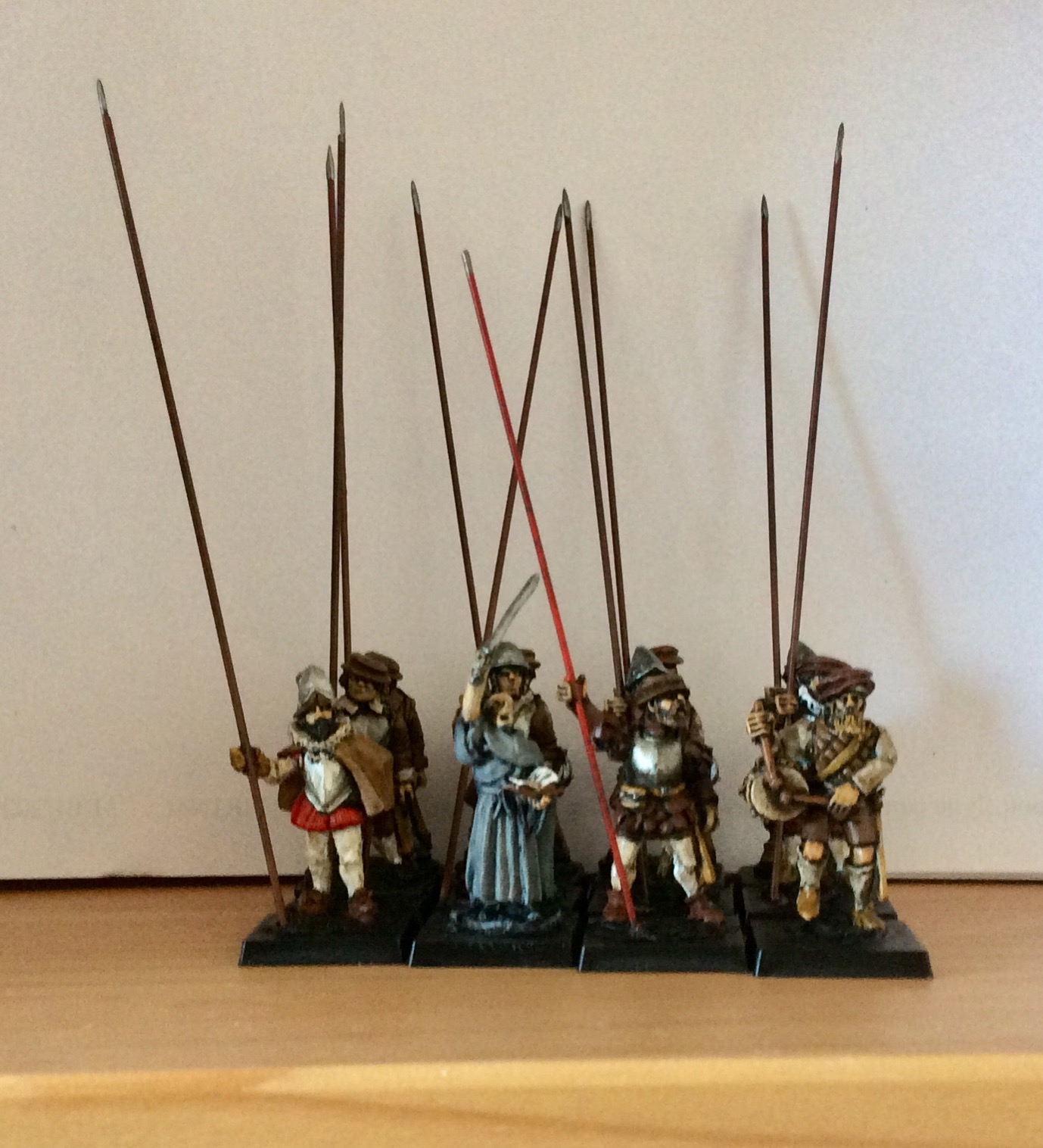
A unit of pike led by their laird and accompanied by his belligerent priest.


Hackbutters.


Some mounted gentry.


At the moment these have a continental look to them, but they would cover the period from the 1540's to the 1570's without too much issue. I have more pike, command and shot on the way and when I have those painted up I will take a look at TAG, Timeline and Foundry/Castingroom. I shall also need some highland caterans and a few gallowglass types. I have some from Sheltrum which may do. A tower house may also be required, which might be a fun built whilst I'm otherwise unengaged!

From my landsknecht game I thought that pike to shot ratios needed some adjustment so I intend having a ratio of two shot units per pike unit max. The shot will be smaller 6 fig units units and cost 6pts and will not have salvo fire. Now PL is a skirmish game so exact ratios need not matter in a raid. But the Osprey on Scottish Renaissance Armies, and that on the Spanish Tercios which I have handy suggest there were at least twice as much pike to shot. A typical PL company could be 2 pike (8pts), 2 shot (12pts) and a unit of Trotters (4pts), which feels and looks right to me.

It's also easy to put together in terms of both figures and time to paint. I'm most of the way through my first company. 😁

Wednesday, 1 April 2020

Lockdown Landsknechts

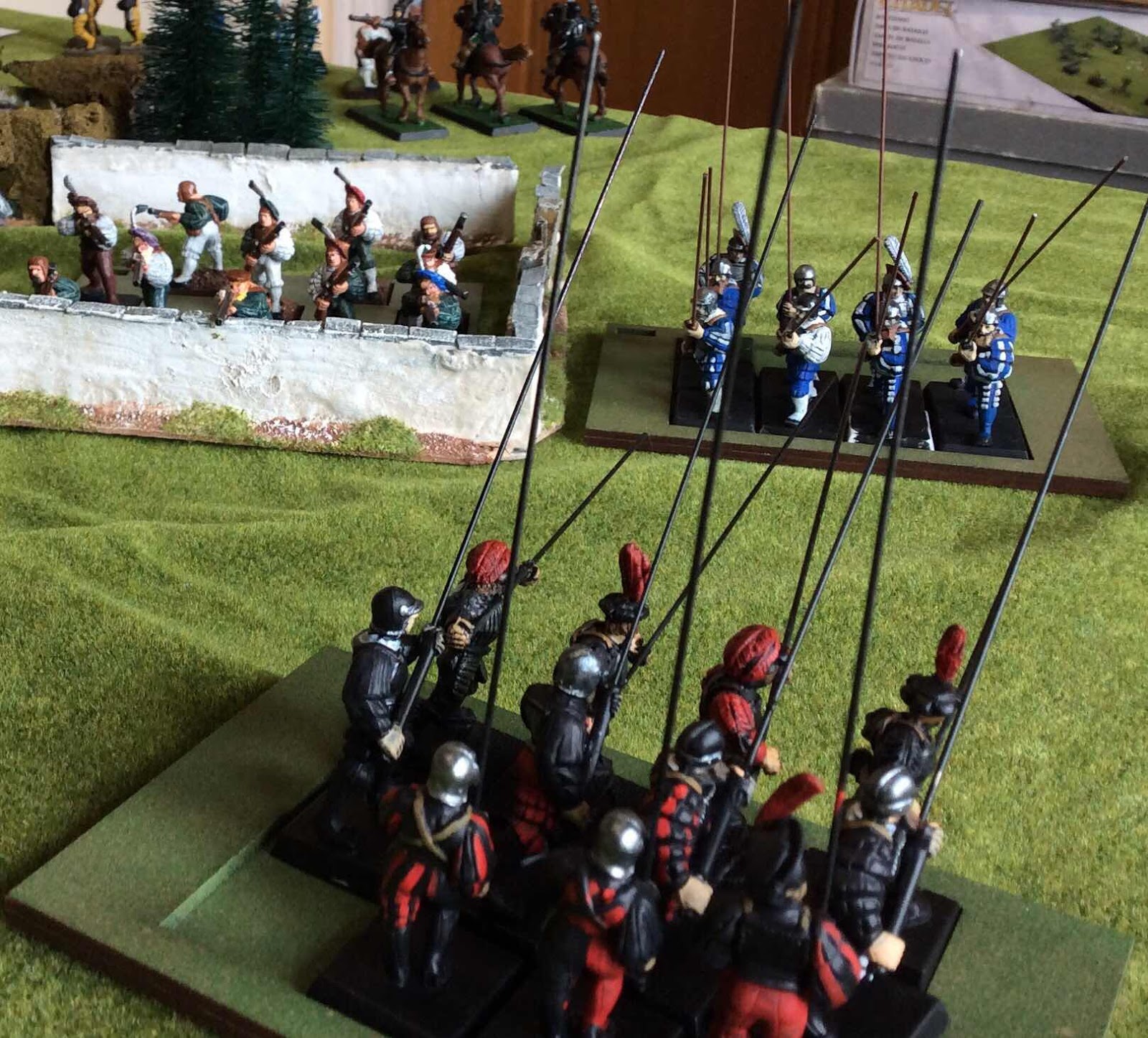
On Sunday my son and I had a kitchen table game of Pikemans Lament using some old GW Empire figures which I had started to roughly convert a few years ago.

On a whim I'd started painting them up again and supplementing my units with a few choices of EBay. Anyone interested in painting true landsknechts and neat converters of figures should look away now 🤣.

For a start these are great sculpts. To be sure advances have been made in plastics and the clothing and poses are basic and other ranges exist now, but when you have to guts of two small armies kicking around in various tubs in the loft and can't go out anywhere why not put them to use.

I adopted a very simple style for painting them and stuck to basic colours for the pike units.  The pike themselves were at first thin plastic rod, but this broke too easily. Then I tried a pin and some thin tubing but this didn't work either. So in the end (look away now if squeamish) I inserted a hot metal wire pike into the figures hand! On the table this looks perfect as you cannot see the join but up close it's a little ugly. Well never mind I was going for overall effect not individual masterpieces. Supporting handgunners had a bit more variety. I added some pistoliers, riding huge fat-ar**d horses and some cannon which are lovely pieces. I looked around for matching figures and tried some Casting Room pike and some Warlord Dopplesoldners. The latter look a little weedy but as an independent unit they do fine. Ebay supplementary GW figures finished things off

The bases for the moment I have left as is. I have yet to decide to use the 3-2-1 style of basing or keep them on square individual bases. I had some sabots which I was going to use for a version of the Ancient Rules which a friend and I play so to try out PL I thought I would use them.

Why PL and not Lion Rampant? I have both but I thought that the former suited the 1500's better than the more medieval focused LR. I imagine these figures as raiders and plunderers engaged in "Bad War" somewhere in southern Germany during the Peasants War, not as pike blocks at Pavia or similar.

I threw down some terrain and drew up two forces. One lead by a bit of a ladies man with a fine moustache but of limited experience. He was accompanied by a large band of average troops, pike, handguns and pistoliers and a regimental gun. Facing him was a different fellow entirely - A rather belligerent lion of a fellow leading an experienced but smaller band of veteran pike and aggressive forlorn hope. My son picked the larger company and I took the veterans.

As this was a test of the rules as much as anything being only the second time I have played them I was just interested in seeing if they felt right for the period and getting a game in. We paid little attention to terrain placement or scenario and just got fired into some across the table action. 


Lew's cavalry scampered round my flank, so I sent the forlorn hope to hold them off, using them as skirmishers. They took some fire from the caracoling pistoliers but caught them and chopped them up a bit and forced them back again and again due to some poor activation roles, eventually they were cut down and the remaining dopplesoldners looked around to see if they could swing into Lew's flank. 


On the opposite side of the table, Lew managed to move his handgunners into a farm complex and took advantage of the cover it provided to shoot up my flanking shot. These two units traded fire for much of the battle without much effect. 


In the centre my veterans, the black band,  advanced while my leaders unit closed formation, and took fire from Lew's cannon. This whittled the, down and they really didn't get a chance to close as they suffered from some poor morale throws and were forced back. That just left the black band and the forlorn hope who were by now in amongst Lew's second unit of shot, having seen off the gun. 

Pike are very strong defensively but I thought my veterans would have the upper hand. They didn't and came off worse in the melee. They took a volley from the handgunners too and reeled back. The forlorn hope had caused some casualties but they'd now been whittled away and so effectively the game was over. It was good fun though and looked and felt right and we both enjoyed it, all the right ingredients for a game.


What would I change. Smaller units of shot. I checked my few reference books and online and figured that I would have much less handgunners or more pike. So I will fiddle with the troop type and costs to come up with right ratio, probably units of 6 shot rather than 12.. Cannon might look good but the Warlord handbusch is a better model for   this size of game and actually none of these fit with the raiding and looting concept so these won't be reappearing except as part of fixed positions. Some light horse might be worth getting. Gringo 40's make conquistadore cavalry and their figs are big and horses large too so 6 of these wouldn't go amis. 

More landsknechts in the future. But it will be back to the Sugar Islands for the next game with some newly painted Maroons.


Sunday, 19 February 2017

More Russians??!?!?!

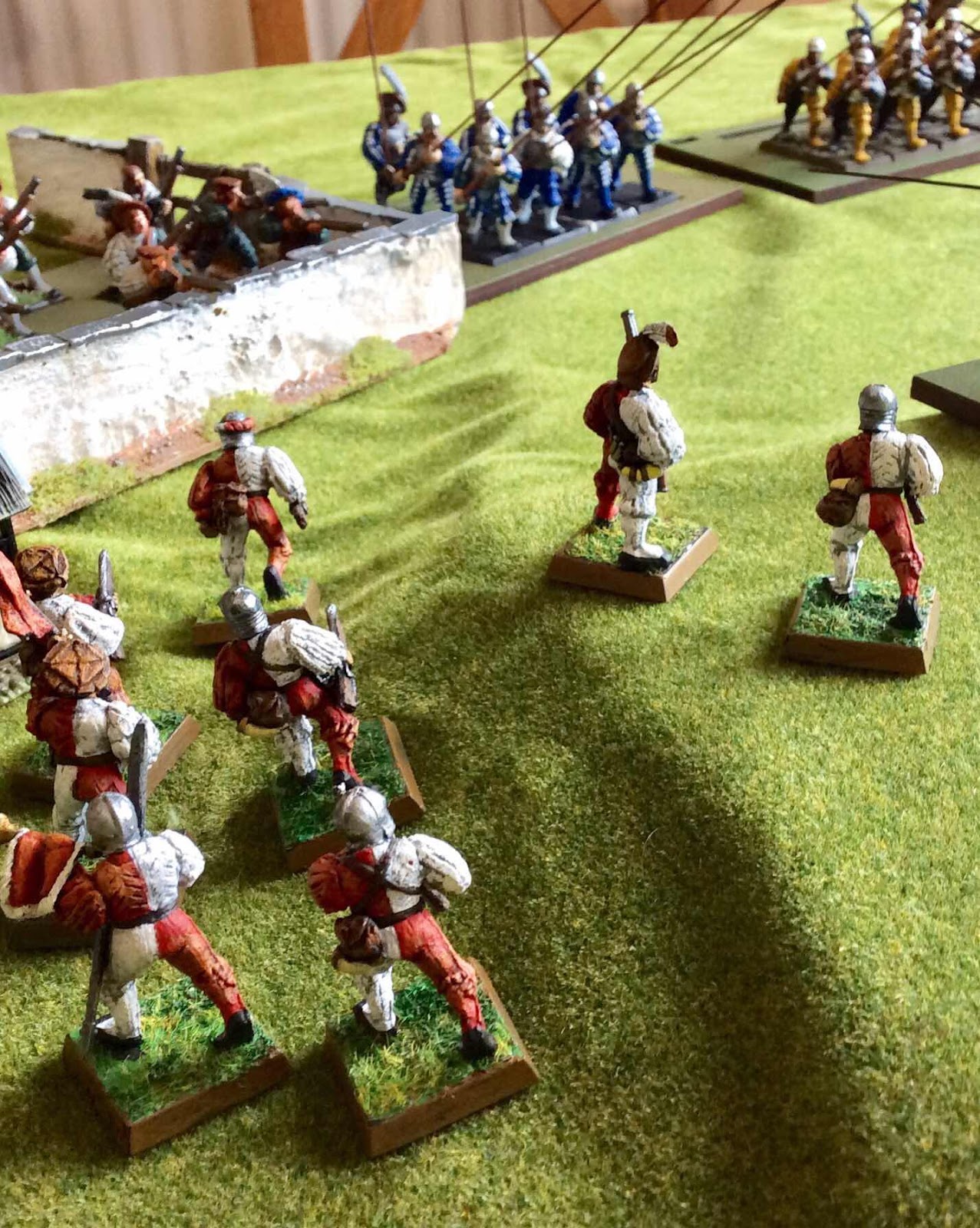
Finished off the last of my SYW Russian foot regiments (for now!) and since the green paint was out I decided I would have a bash at painting up some Russian Great Northern War figs, the stuff I bought from Grimsby gamer Paul Robinson last year at AMG. 

Last of....


I'm going to make up a company for The Pikemans Lament as there is enough bare metal to get what I need out of the Russians. The swedes don't have enough figs and anyway the company who made them seems to have unlisted them....most helpfully. So they'll have to come from another source, probablyWarfare. Russian cavalry might have to be Foundry stand ins. I don't know what it is about this period and ranges, they pop up, never get finished and die out just as folk get ready to move onto another stage! 

TPL foot units are 12 figures and as I already have 12 shot and 8 pike painted I have no excuse not to get started. I also picked up the excellent, but rather expensive, GNW Compendium last year and with the old Osprey Peter the Great and Poltava books and the Peter Englund book I've got plenty source material. Keeping this in the 18thC means no period creep too - I had thought about going rennaissance but managed to reign that in. (Er....but not until I bought some pistoliers, seen lurking in the above shot!). 

First of....