Monday, 11 May 2020

16thC Distraction - Corrichie


The Battle of Corrichie.

In 1562 Mary Stewart, Queen of Scots, had given her protestant half-brother, James Stewart, the title Earl of Moray in order to reward his service to the crown and to counterbalance the power of the conservative catholic Earl of Huntly who controlled most of north east Scotland. Huntly was not at all in the Queen’s favour due to his family’s feuds with other lords, but he squandered whatever chance he had to regain it by failing to appear before her in Aberdeen and submit and then allowing one of his son’s to shadow her progress to Inverness with a large band of armed men. At Inverness matters worsened when the Queen was initially refused entry to the castle which Huntly controlled. Huntly was called to account and ordered to give up the family castles at Findlater, Auchindoun and Strathbogie and appear before the Queens privy council. Huntly did not like the odds. He sent his wife to bargain for him. By now Mary had taken her full of him and had him declared an outlaw. She dispatched riders to take him at Strathbogie, but he managed to escape over the castle wall without so much as “boote or swerde” and made off for another of his holdings at Ruthven in Badenoch on the other side of the Cairngorms.

There he schemed and called his family and supporters to him, hoping to raise an army of 20,000 as he had boasted that he could a couple of years before. However, the winds had changed and many of his former allies sensed this and when the chips were down, failed to come out for him.

He set out from Ruthven towards Aberdeen in late October. He may have hoped that some would rally to him on his march and that his army would swell as it moved east. However only his sons Lord George, Sir John and Sir Adam Gordon, his cousin the Earl of Sutherland and some of his Gordon kin followed him – Black Alistair Gordon of Abergeldie, George Gordon of Blairdinnie and William Gordon of Terpersie. Others such as Abercrombie of Pitmedden, Douglas of Tilquillie, Irvine of Drum, Bisset of Lessendrum and Menzies of Pitfodels also joined. A glance at a map of the lands around dee and donside quickly gives the impression that none of these men were great landowners and even in a time when the countryside was more densely populated most of these others would have contributed only a few dozen men at best. Many stayed away and some, such as Gordon of Haddo, even joined the Queen’s forces. Thus, with between 500-800 men, Huntly reached Garlogie, about 12 miles from Aberdeen and camped not far from the loch of Skene.

Moray had not been idle. Whilst Huntly had been in the hills, he had summoned pike and shot from Lothian and Edinburgh to supplement the militia from Aberdeen, of which he was sheriff. He also had a unit of horse, bringing his total to near 2000 men. Learning of Huntly’s approach he sent the Earl of Errol, Lord Balqhuain and Lord Forbes with his mounted men to beat up Huntly’s camp at Garlogie in a dawn raid on the 28th of October. Moray himself brought the foot from Aberdeen.

The raid forced Huntly to realise he did not have the strength to take on Moray and he began to retreat, back the way he came. He stuck to rough ground, hindering the cavalry and pikemen of his foe and made for high ground a few miles from his camp. He crossed a burn and turned at bay on a spur of the Hill o’Fare, probably around the Meikle Tap, which rises steeply above the surrounding country, hoping this would favour his troops and even the disparity in numbers.

Moray was now at hand, having followed with his foot. By mid-afternoon it was time to fight – there was little daylight left. His shot drove the Huntly’s men from their position, down the hill and to the west into the Howe of Corrichie. He sent his horse up to deal with them, his pike following.  The horse could not finish them off due to the boggy ground along the burn. But Huntly was now pinned, with steep ground at his back and his enemy close by. Moray sent in the Aberdeenshire men first, but perhaps due to former loyalties, perhaps faced by desperate men or even simply because of poor training and bad ground they broke and fled back and around the Lothian men. Huntly led his men forward, determined to follow up this small success, however the Edinburgh pike were steady and the Gordon’s could not get within range to use their hand weapons against the closed ranks of pike supported by the horse and shot. Now it was the Gordons turn to break and with nowhere to go they had little chance but to surrender and take their chances or die.

Some 200 or so of Huntly’s men lay dead amongst the heather. Over 120 were taken prisoner. The rest, dead at Garlogie or fled in ones and twos into the October gloom. The battle had lasted for under an hour. Huntly himself surrendered his sword and was taken before Moray. As he was led away he “sodenlie fawleth from his horse starke dedde…” succumbing to a seizure or heart failure. Bar the recriminations, it was all over.

Tomorrow… refighting the battle.

Thursday, 7 May 2020

16thC Distraction - Moray's Arquebus

Monday's order from Casting Room, Wednesdays delivery and Thursdays paintjob.

At Corrichie Moray brought trained troops from Lothian to fight Huntly. Both pike and accompanying shot to stiffen the levy raised from Aberdeenshire. These men carry heavier arquebus which need rests, unlike lighter calivers.

These complete my representation of Moray's force.


 A detailed summary of the battle will follow tomorrow while I await on an order from Perry to represent Huntly's Gordon's.

Monday, 4 May 2020

16thC Distraction - Moray's Pike

I continued with my distraction over the weekend. From now on mornings will be job, CV, and "constructive" time whilst afternoons will be spent on "Against Spain".

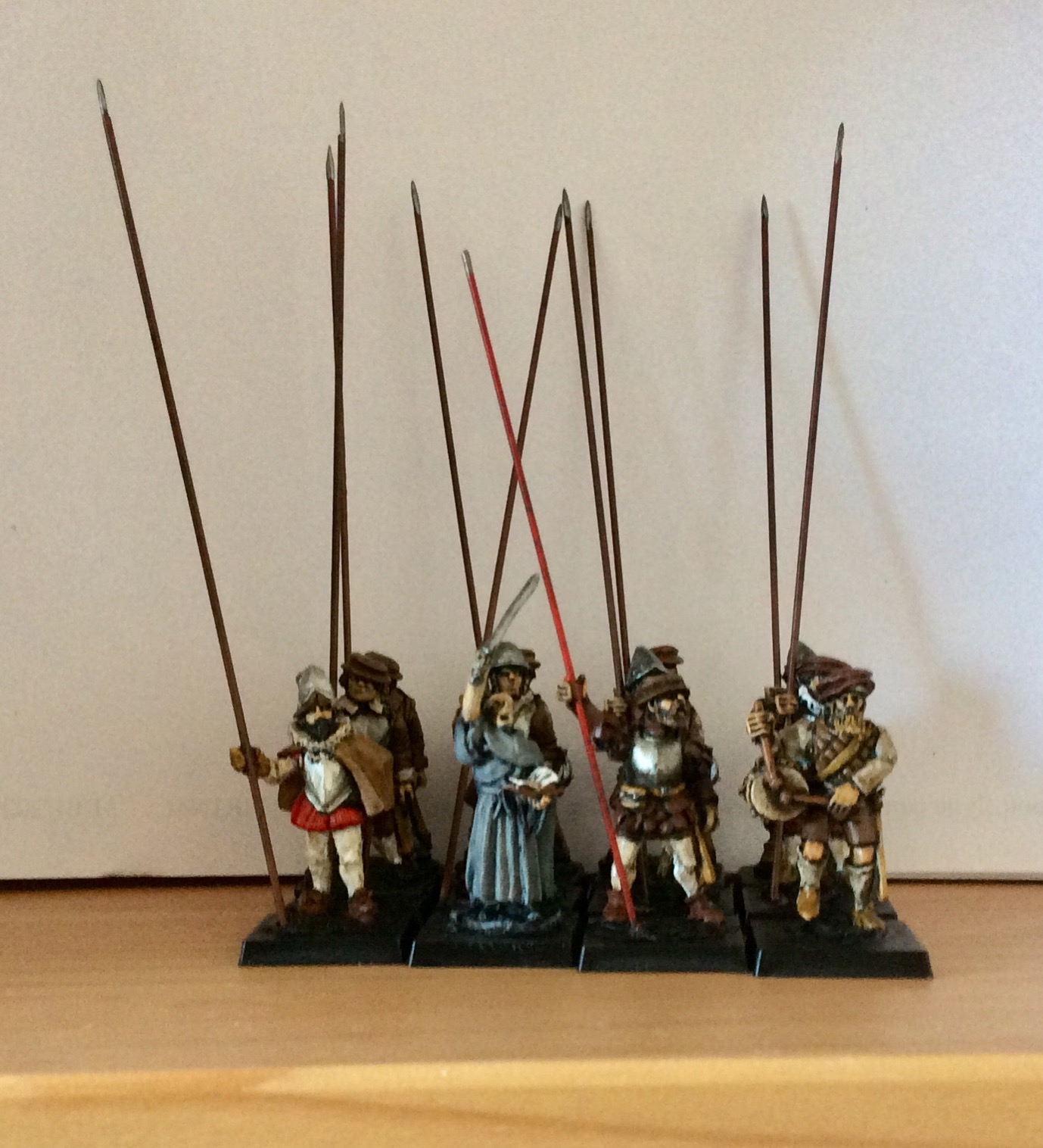
James Stewart, Earl of Moray led the Marian Force or Queens men at Corrichie in 1562. At the battle he led his pikemen and halted the attack of the Earl of Huntly's men, leading to their defeat. 

Moray's army comprised of 2000 men including cavalry, pike and arquebus. A significant number of these must have been lowland Scots, rather than Highlanders given the equipment described. So I wanted to depict some men from Moray's own household as a unit rather than just a collected body of called out men from the local area. I used more grey in their clothing, with brown colours for jacks and white for shirts and hose, rather than the browns and beiges of the previous pike unit. 

The unit is led by Moray himself, with a standard bearer, his drummer and a captain of some experience. Moray wears black, following a portrait of himself as a young man, decorated with gold. The drummer is clothed in white and off white , probably the son of someone connected to Moray's house. The captain wears a burgeonet, breast and back armour with a buff coat under it and carries a wheel lock pistol. He represents either Wishart of Pitarro or the Tutor of Pictur who are credited with leading the pike forward through the retreating advance guard, halting the Gordon charge and ending the battle.


The figures are Foundry Swashbuckler pike, led by Castingroom Command an an Elizabethan Foundry Drummer. Flags and bases will be done once everything is finished. 

Wednesday, 29 April 2020

A 16thC Distraction

A while back, a loonngg while back, I picked up some Foundry Elizabethan, Swashbuckler and Conquistador figures from sales, eBay and the Lead Adventure Forum. These have languished in a box on the lead pile since then. I was interested in doing something based around the Marian civil war and the Gordon-Forbes Feud, both of which rumbled around in this part of Scotland during the 1560's and 70's. Information is a bit scarce on either and finding a ruleset which covered the skirmishes and small affairs from a few dozen to a few hundred men aside in the late Renaissance wasn't easy either. So in their box they stayed.

Then along came Pikemans Lament. Interest was rekindled. It smouldered a bit.

Next came lockdown and an unplanned career break. Great timing. Thanks.

So, I plundered the lead mountain and up they came. I found a few articles and a mention here and there on forums and I thought why not make this a wee project. So I painted them up.

A unit of pike led by their laird and accompanied by his belligerent priest.


Hackbutters.


Some mounted gentry.


At the moment these have a continental look to them, but they would cover the period from the 1540's to the 1570's without too much issue. I have more pike, command and shot on the way and when I have those painted up I will take a look at TAG, Timeline and Foundry/Castingroom. I shall also need some highland caterans and a few gallowglass types. I have some from Sheltrum which may do. A tower house may also be required, which might be a fun built whilst I'm otherwise unengaged!

From my landsknecht game I thought that pike to shot ratios needed some adjustment so I intend having a ratio of two shot units per pike unit max. The shot will be smaller 6 fig units units and cost 6pts and will not have salvo fire. Now PL is a skirmish game so exact ratios need not matter in a raid. But the Osprey on Scottish Renaissance Armies, and that on the Spanish Tercios which I have handy suggest there were at least twice as much pike to shot. A typical PL company could be 2 pike (8pts), 2 shot (12pts) and a unit of Trotters (4pts), which feels and looks right to me.

It's also easy to put together in terms of both figures and time to paint. I'm most of the way through my first company. 😁

Tuesday, 14 April 2020

Spanish Dragoons and Militia

For my next project (and book), I need some Spanish dragoons and Militia.

These figures represent the Edimburgo Dragoons which were stationed on Cuba and took part in the defence of Havana. Their yellow coats and blue facings really contrast with the plain white of Spanish line infantry and are the reverse of the Havana garrison uniform so make a flash of bright colour on the field.


(The regimental name is correct, in English they would be the Edinburgh Dragoons).

The infantry figure is a test paint for the Havana Blancos, a local militia unit. The Havana militias were all reorganised when city was returned to Spain after the SYW and all the illustrations, including the one this figure is based on, date from that later period. Prior to that it's not clear exactly what was worn and what was carried. It's likely that only officers and some men wore uniform and carried full equipment as large numbers had to be equipped with pikes and were not committed to any offensive action against the British. However I've chosen to paint a few spare figures which I have in the later uniform.


There were three militia units, the Blancos, Pardos and Morenos. 

The Blancos were European citizens whilst the Pardos were men of mixed parentage. The Morenos (lit. "moors") were freed slaves. Again this information is post siege so in reality there may have just been a "Militia" which free men could join. This being greatly expanded when the English arrived and then reorganised into these distinct and more formal units later.

Below is a illustration of a soldier from the Havana Morenos wearing his post siege uniform. Hopefully castings of these will see the light of day at some point.