Showing posts with label Marian Civil War. Show all posts

Thursday, 23 November 2023

Renaissance Games Continued

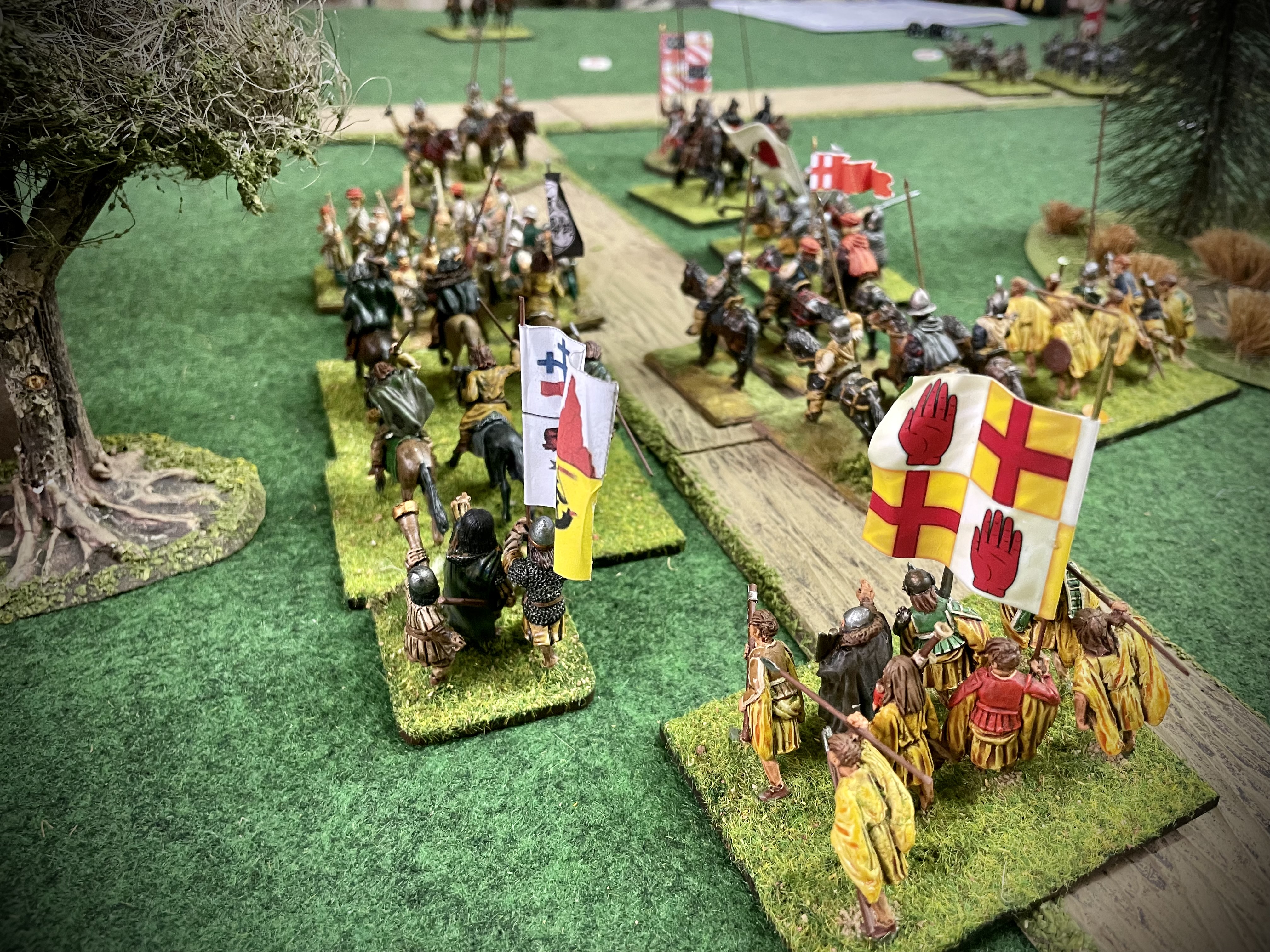
Two more games this week this time getting the Irish out for a test drive. 

Now I'm no expert, but I'm learning fast and so my knowledge of Irish warfare is limited to Ian Heath's 16th Century Armies and the recent Tudor Warfare Vol2 by Jonathan Davies supplemented by a wee bit of Gush's Renaissance Armies. A broad though shallow sweep. 

How to represent them on the table?

  • Kern as Infantry but able to fight and move through bad terrain
  • Gallowglass as Swords - no change there
  • Irish Cavalry as Reiter - not Caracoling but skirmishing with darts, so no change
  • No Cavalry - so can swap for loose shotte (essentially skirmishers), or more Kern or Gallowglass
  • Irish can have a unit of "normal" pike and shot infantry 
Remember these are a very very simple set of rules which aim to represent warfare distilled to basics so the subtleties may be lost. But this is a tough one because Kern may be main type of Irish infantry but they don't fight in the same way as a pike unit. 

So now we have .

  • National type army lists (basic but getting there)
  • Card driven activation (tried last week and works well)
  • Random events when the random event card was drawn (not tried yet)
  • Leaders with traits which could effect the game (not tried)
  • Campaign rules with casualty recovery. (not tried)

Game one - Capture the gun

Both sides tried to capture a cannon which had become bogged down in a ford. The side which held it at the end of the game won. Not very subtle and probably favouring the English but the random activation meant that either side had complete control. I've also introduced Random Events so there were a few time when things went "agley". The English were lead by an officer keen on glory and leading from the front but this was a game where shooting would be handy. The Irish on the other had had an officer who had god in his side and who could rally off hits from units he was attached to by his inspirational presence. Things were perhaps more even. 

Both sides moved up to the ford and the line of the river, but as expected the English had the upper hand. The Irish weren't able to get to grips, but their skirmishing horse did wear down the heavier English Cavalry and Border Horse and drove them off the table. This gave the English a bit of a wobble and forced one of the back. The Irish had meanwhile be somewhat restored by their inspirational leader and now had the advantage of numbers but pressing the attack was difficult. The worn out English lost another unit, now down to three. This unit had the English leader, still spoiling for a fight and he was slain and in the morale test another ran off. Suddenly there were only two English pike, a ways from the ford, leaderless and without any powder.....the Irish had won. 

The tweaks to the rules had made the game interesting, challenging and given a good player the opportunity to get the best from his troops. Most importantly everyone who played, enjoyed it. 


Game two was a scenario from the One Hour Wargames book. This time the English deployed two units just below a cross roads flanked by difficult ground (bog in our games). There was some debate about whether the Irish would drag their new cannon along.  The decided it would be worth the effort - it wasn't. It fired a shot and ran out of ammo, perhaps fitting given they weren't known for deploying them! Their men surged forward, Gallowglass moving through the bog to try and flank the English. Their first move didn't go well - after taking casualties from the Irish horse one unit drew a random event and recoiled a full move, leaving the other unit dangerously exposed.  A series of short turns however meant they were still fighting when their cavalry, weakened by the last game, but still functioning, turned up and stopped the Irish advance, the solid ground between the bogs was now a bottleneck and units had no space to deploy to shoot or turn to fight. Time was running out. One unit of English infantry were wiped out and the Irish cavalry dashed for the crossroads but they were shot down by English calivers. That was the last turn and the game was over. 


Two games so good results and the rule amendments seem to give good games too. The Irish need some work to make them a bit more skirmishy but not much. I do need some more figs. Some Irish horse and handgunners as well as that Pike a Shot unit.

Wednesday, 15 November 2023

More Renaissance - Rules Additions

Tuesday night is games night at Oldmeldrum Wargames Club and over the last few weeks we've been playing using Neil Thomas's One Hour Wargames Pike and Shot Rules. These are very simple and have straightforward mechanisms which give a good, basic, game when the scenarios in his book are used. Over the last few weeks I've added a few tweaks here and there, not to the rule mechanisms but more gloss on top. 

These include

Officers who can do a limited number of beneficial activities such as rallying off hits and modifying dice throws. 

National troop types which are a little more representational of of the units which made up armies of the time, players being able to swap out swordsmen for artillery or units of "Loose Shotte" for example.

A card based activation system. Lifted from "Victory without Quarter" each unit gets a card allocated from a standard pack, each leader gets one, there's a random event card and a turn end card, so a little unpredictability enters the game. 

And a very simple campaign system for tying games together. Casualty recovery, officer traits and a few other bits. 

We've tried out some of these (officers, army break levels) over the last couple of weeks and they've added  to the games but last night we tried the card activation system. We would probably have had artillery on the table too, but none of the armies rolled up got any swordsmen so no one had the option to swap. (The reason I picked swordsmen as the unit type to play around with was that by the mid and late 1500's most armies had dropped their sword and buckler types, polearmes, etc and moved to pike and shot. The Irish and Highland Scots being exceptions along with the English Billmen who still showed up when the levies were called up).

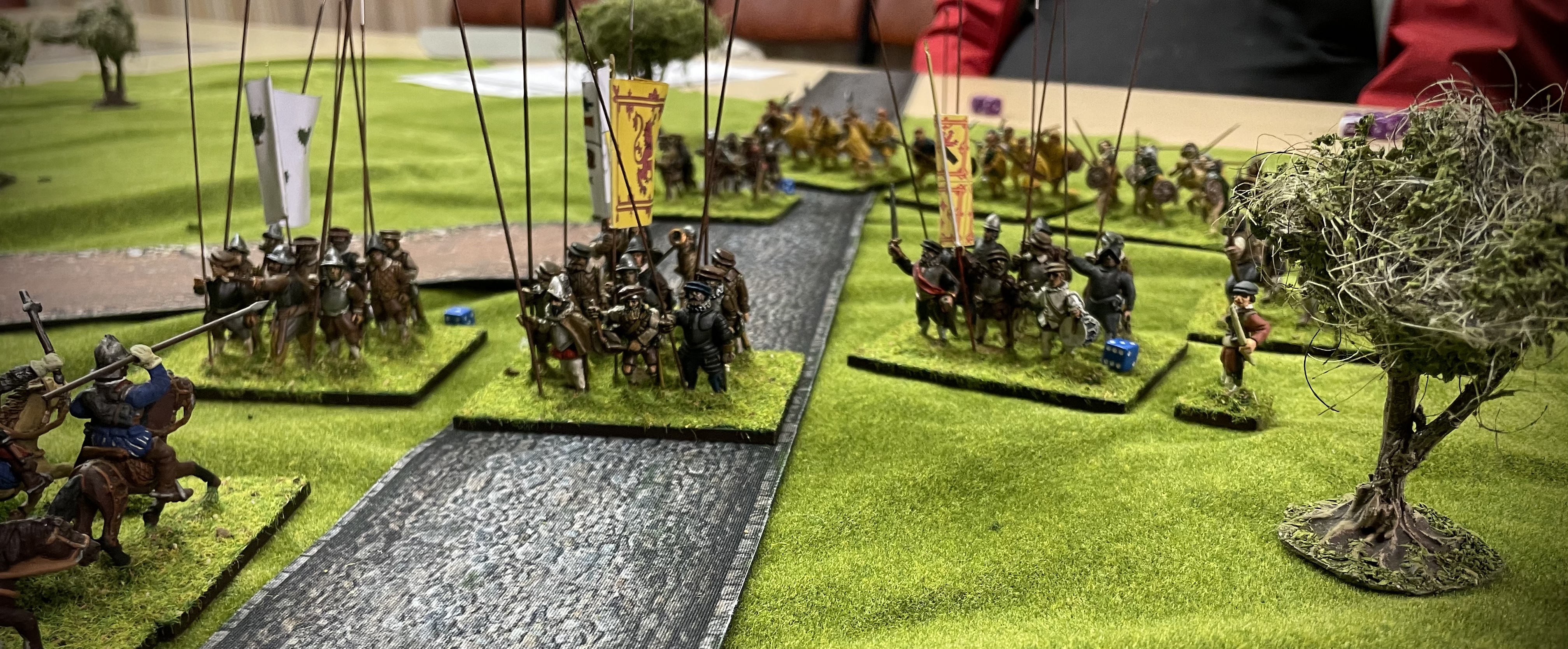
We played two games from the book with 6 unit armies. The Spanish with 4 infantry, 1 Cavalry (demilancers) and 1 Reiter and the English with 3 infantry, 2 Reiter and 1 Cavalry. 

The games played out well with the initial friendly frustration of seeing red card after red card being drawn for the English being reversed then a few hands later the opposite occurred.  The turn end came up too early sometimes and too late at others meaning the players were always quite able to do what they wanted when they wanted, a good way of representing the lack of control senior command had once battle was joined. It also meant that the second game was a tactical draw despite the Spanish being hammered by the English as the latter were unable to achieve their objective of seizing the crossroads. 

4 players involved, two games played, nice figures shuffled about, battles that had a good period feel to them...whats not to like. 


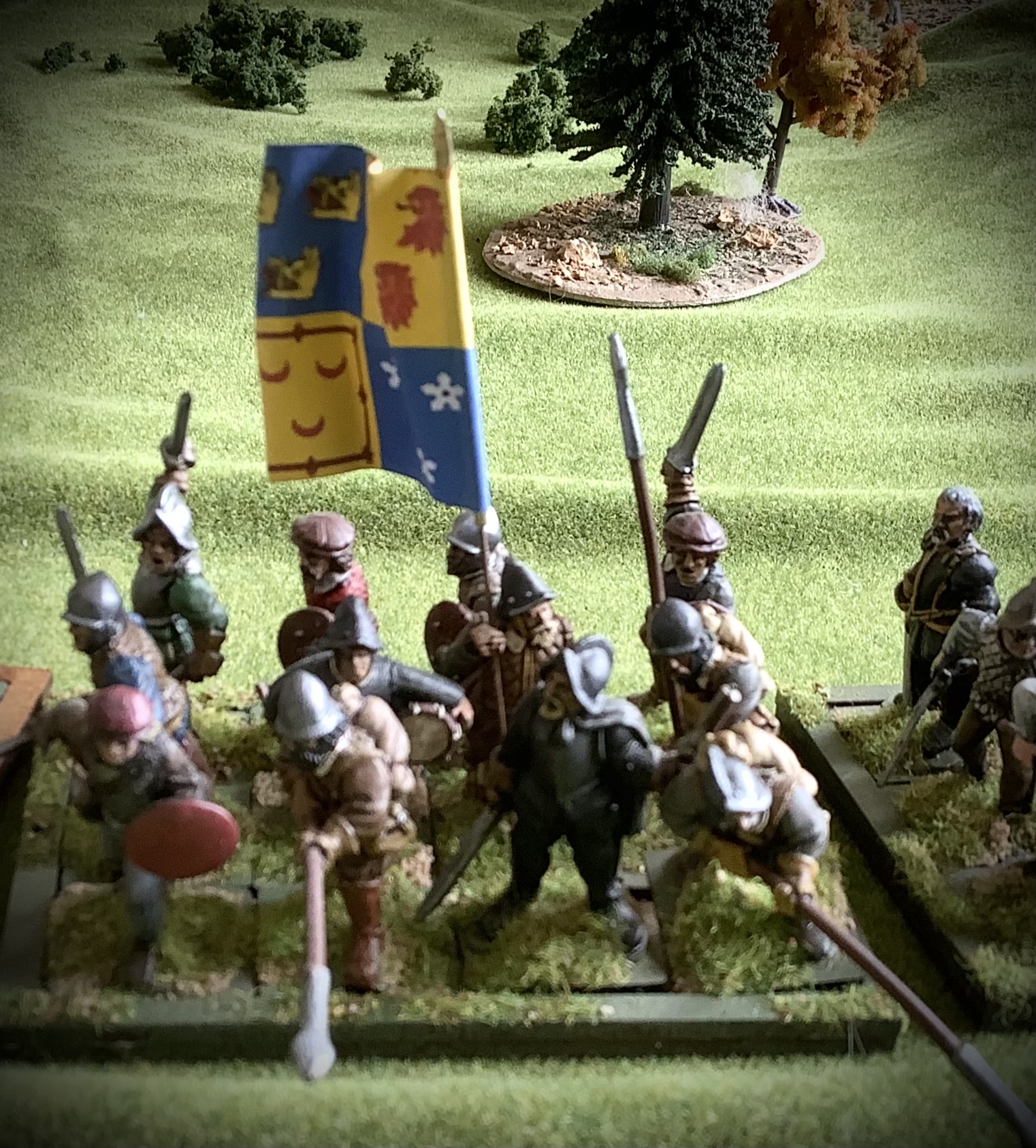
Game one. Spanish hold the hill expecting an attack from the English to their front but are surprised when they attack from the flank. Flags from the excellent 80Years War Facebook page except the Burnets in the foreground!


Although pressed hard the Spanish were just able to retain control of the hill. It was a hard fight and casualties were heavy on both sides. 

Game Two


Playing rather than umpiring this time I had command of the English right. The scenario called for both sides to control a small hill in the SE corner and a crossroads in the NW, a difficult proposition. I wanted to see if I could use Reiters to "shoot in" my demilancers. 


Almost! I was able to drive off the Spanish Cavalry which Dave commanded on that wing but the infantry proved to be too tough a nut to crack. Out of powder and shot, my LHS unit of Reiter galloped down the flank but couldn't quite seize the ground before the turn end card called end of play. On the English right John's infantry did a good job of whittling away the other Spanish units, led by Alistair, but couldn't get close enough to threaten the crossroads. 

Had these been campaign games it's likely the Spanish losses over both battles would have left them unable to to fight a third battle. We will put that to the test next week. 

Reiter units for the English also need to be looked into. At home or in Ireland I expect they'd be more skirmishing Border Horse, but in the Spanish Netherlands or in France they'd be more common, as part of an allied army. There aren't rules for skirmish cavalry so some thought is needed if I'm going to have games in Ireland or agains the Scots.


Tuesday, 7 November 2023

16thC Spanish

Continuing my 16thC project Ive assembled and painted quite a few of the Wargames Atlantic Conquistador figures. These were painted almost exclusively with Citadel Contrast Paints, Army Painter Speed Paint and Strong Tone Wash. only the white/off white and greys were "normal" paints. These were applied over a Khemri Dust (khaki-ish) primer. Flags are from the 80yrs War Facebook page and Flags of War picked up at Kirriemuir. 


Taking a leaf from Matakishi's excellent Renaissance project I have added priests to all my Spanish units. One seems to praying for deliverance rather than victory though. 

Supporting them are some Citadel Pistoliers. 

I've one more unit of pike and shot to do and using a mix of conquistador bits and warlord landsknecht bodies I have a unit of billmen - they'll join the English. Lastly I have Resin demi lancers and gendarmes and warlord mounted arquebusiers to paint. 

Why Spanish?

Well the Gordon's and the Hay's did not end their support for Catholicism with the crowning of James VI. They were implicated in a plot to involve Spain in Scottish affairs and took advantage of the ships of the stricken Spanish Armada to equip themselves with Spanish cannon, if indeed they had not already done so secretly. One of these lies amongst the ruins of the Hay's castle of Old Slains above St Catherine's Dub near Collieston. Here my father took me as a kid for my grandmothers family had a cottage there and I remember the gun sitting on the headland in the shadow of the ruin, blown up by James in revenge for Hay's treachery. Another cannon sits outside Haddo House a few miles west of my home, and a modern home of the Gordon's, while a third is at Peterhead Museum, just up the road. 

Then there was the Spanish ship which stopped off in Tobermory Bay and whose crew were used by the McLeans of Duart to settle some feuds with the MacDonalds and MacIans before the ship was destroyed on the orders of Walsingham, Elizabeth I's "spymaster". 

Who needs to wait to the Jacobite rebellion and Glen Sheil before you have Spanish in the Heather?!


Sunday, 22 October 2023

Some Renaissance Figs

Today's paint jobs.


First some Spanish pike, complete with frothing priest which will accompany my Spaniards. A bit of stereotyping but why not. Wargames Atlantic Conquistadors and Foundry/Casting Room “command”. The plastics are ok....some pieces are a bit smooth and lack detail while others give a bit of an ape like look to the finished pose. Based together though they look ok and I've got enough with two boxes to give me two bases of pike, the shot to go with them and to make up some halberdiers/bills and Spanish cavalry using the Perry WOTR Light Horse set.

I will add a flag from the rather excellent 80 Years War Facebook group. It has flags for Spanish units which are rather colourful, correct for the period and a change from the usual red and white. 

We'll see how long the plastic spears last.....


Next some rescued Empire Pistoliers. Tails repaired, armour calmed down, mounts retouched and plumes repainted.  Citadel bases trimmed off and dremelled down in thickness, then the figs fixed in place with a mix of superglue and pva to give a strong flexible bond between the plastic and the mdf. I have some redoubt figures on order...(will see how long they take to turn up!), but I'm hoping they're a good fit size ways as these are nice figures, particularly the firing pose, but I'm two short for a unit and I don't want to pay the daft prices they go for on eBay.


Have to say I’m really enjoying painting renaissance stuff and am working my way through the 2nd and 3rd Tudor Art of Warre books from Helion and their One Faith, One Law, One King book on the armies of the French Wars of Religion which arrived today. I have a core of pike, shot and mounted figures now to which I am adding units to give the army a flavour of one nationality or the other as well as interchangeable flags. I have my eye on some nice resin figures as French. 

We had a game at Oldmeldrum Wargames Club last week using Neil Thomas’s One Hour Wargames with a few mods by yours truely. We will give them another go this week - weather permitting! I'll take some pics this time. 

Thursday, 1 December 2022

Wargamers Annual - Wars of Mary Queen of Scots


The Wargamers Annual is now available from Caliver Books. As mentioned in previous posts this includes an article by Angus Konstam and myself on the period and figures which can be used as well as an article on the Battle of Corrichie written by me.

Tuesday, 29 November 2022

More 16thC - Glenlivet

Although not part of my series of Gordon-Forbes feud and outwith the scope of the Marian Civil War we fought the Battle of Glenlivet, 1597 at the club tonight. 

The battle was fought between the Catholic Earl of Huntly and his allies, primarily the Earl of Errol, and an army representing King James VI, led by the young Earl of Argyll. 

Argylls army was made up of levied Campbell foot armed with pike and shot and highland clansmen and was not a well motivated or well led force. The clansmen were the most effective troops but were no great fans of Argyll and his own men couldn't wait to get to get home. 

Huntly and Errol's force was about 50% light horse m the rest was fairly well motivated foot from north east Scotland, mostly Gordon's and their allies but also a battery of 6 guns.

The battle seems to have been an encounter, but Huntly seems to have been aware of Argyll's movements as he was able to deploy his guns in what is not the best terrain for such armaments and use them to effect. 

It was Errol who opened the battle, his horse charging the van of Argyll's force - his hand gunners and archers, at high cost while Huntly deployed to some high ground. Argylls levies were hopeless and the only troops to have much effect were the clansmen, the McLeans in particular. The battle went the rebels way and Argyll was defeated, but it changed little. Huntly had to spend time in exile and Errol's castle of Old Slains was destroyed with gunpowder on order of King James. 

Our game got off to a false start as I'd allocated levies to Argyll and they melted away without any effect. So we reset things and tried again with them as light foot. The second game was closer. Errol's horse were in the thick of it, but then the Gordon foot became to close and Argyll fell in action bringing a courage test for his battered army. The results were not good and several units broke and fled and what was left wasn't enough to be in any state to continue the game....victory for Gordon and Errol.


Sunday, 27 November 2022

A bad day for Forbes.....Tillyangus and Corgarff

 Today I had a couple of games today with some friends to test scenarios from my next book, Feud, which covers the Gordon - Forbes feud and the Marian Civil War in the North East of Scotland in the 16th century.

Having played out Corrichie and Craibstane previously, Tillyangus and a fictional scenario involving the burning of Corgarff Castle were on the table today. 

We used Lion Rampant 2nd edition with few of the amendments suggested in the Renaissance Rampant mods which were in Wargames Illustrated, written by Oli of the rather excellent Camisado Blog. I am now quite happy that Lion Rampant and not Pikemans Lament make for a better set of rules for this period - perhaps it's the minor changes to second edition or that these skirmishes between rival families are more suited to a medieval style of warfare despite being set in the latter half. of the 1500's

We opened with Tillyangus - here a band of Gordon's led by Adam Gordon, brother of the Earl of Huntly, and on their way to Edinburgh were attacked by the Forbes's under Black Arthur Forbes of Balfour. 

I have a different view of the battle from the presented in Marren's Grampian Battlefields and wrote the scenario based on the points I set out in the book following a visit to the site and a review of the sources, archaeological findings and some practical considerations too! But to the game...


The Gordons came down the road from Auchindoun through Clatt and bumped into the Forbes men. Both sides tried to find an open flank but it was the Gordon hackbutters who caused the damaged to the Forbes foot and softened the way for the Gordon's to drive the Forbes out of their position and back towards their castle of Druminor. The melees were sharp and bloody and Black Arthur fell not far from the Forbes position, instead of during the historical rout, but otherwise the outcome was the same and the Gordon's won the day.

After a spot of lunch and a catch up we played my Corgarff scenario. 

After defeating Forbes again at Aberdeen, Gordon now had control of the North East and set about making sure his enemies were completely subdued. To this end he rode to lonely Corgarff castle, high up on Donside where he found Lady Forbes of Towie and her family. As is told in the traditional Ballad Edom o'Gordon, Lady Forbes did not surrender and barred the tower door against Gordon, (or his henchman Kerr). Frustrated by this, a fire was set and the tower burned down, with the unfortunate Forbes family inside. In the scenario I have Forbes of Towie riding to the rescue with horse and local foot, racing to drive of Gordon and Kerr before it is too late. 

In our game the Forbes's arrived and drove Kerr and his men off,  but Adam Gordon proved more difficult and with his horse cut up first one and then a second unit of his foes, ultimately breaking and routing them from the field. There was to be no rescue this day! It was a close game though and the had the dice gone the other way it would have been Adam Gordon routed, so the scenario was balanced. 


Two good games with John and Eric taking the Forbes's and Bill taking the Gordon's.

I have a few minor tweaks to make to the scenario's as I've written them and then the last few paragraphs to write before proofreading and off to the publisher, ready for printing in the new year. 

Friday, 11 November 2022

Patriots Rebellion & Retreat from Kabul - Artillery Crew

 Artillery crew. The fellow in the fine helmet is a Bengal Horse Artillery gunner. 

He won't be serving in Canada but will be on the retreat


I also rebased my 16thC Irish/Highland Scots to match my other 16thC stuff. A mix of Perry and Scheltrum figures left over from when I painted figures for the Harlaw anniversary game. Currently flagged up as Irish I can switch them over to Huntly's missing allies from Badenoch and Sutherland should I please, or even the highlanders who fought against the 6th Earl at Glenlivet. 


Saturday, 22 October 2022

Feud - 2 more local battles - Tillyangus and Craibstane

Following work to finish off my shared article with Angus Konstam on the Marian Civil War and the Battle of Corrichie I had a chance to review my existing notes and maps for two other encounters between the representatives of the factions fighting to control the throne of Scotland and settling their own scores into the bargain. 

At Tillyangus Black Arthur Forbes tried to stop a band of Gordon's from getting to Edinburgh by blocking  their route south - it didn't go well for them. 


At Craibstane, the Forbes family with professional troops tried to drive Adam Gordon from Aberdeen, which he was holding for the Queen. The fight took place at the edge of  the town and once again it didn't go well for the Forbes family. 


What makes these two battles interesting is that neither is a pitched battle. At the former the Forbes's tried to physically block the road and destroy the Gordon's against their position. At the latter Adam Gordon's men were of variable quality but many were defending their homes, fighting amongst the gardens and plots that made up the towns unfortified boundary. Tillyangus is fought hand to hand whilst Craibstane has lots of firearms and bows. The area around Clatt near which Tilllyangus was fought is still mostly open farmland, however Aberdeen has long since overrun the area over which the Gordon's and Forbes's fought at Craibstane - even the stone itself has been moved. It is possible to trace the line of the original road into town from the medieval Bridge of Dee. 


So earlier this week I drew the maps for each game and had a chance to test one scenario which seemed to go ok.


As a wee taster, here are the maps for the two games.


Saturday, 17 September 2022

Holidays - Leeds Armouries

On holiday in York for a week. Very relaxing. Visting old haunts as this was the first place my wife and I went on holiday together before we were married and it was our 30th Anniversary this week.

The weather has been wonderful and we have been out and about. York is a wonderful city and there is plenty to do, but we also made time to go a little further afield, to Leeds, as I wanted to see the Royal Armouries. 

Plenty of excellent exhibits all both well labelled and contextually described too. I sat through a talk on Flodden (hmm well not much about the battle just a bit on being in the fighting, and from a archers perspective - I think a missed opportunity there!) and a rather more lively swordplay demonstration. The Medieval and Renaissance galleries cover tournaments and battles and have lots of shiny gear to see. Upstairs the Oriental gallery covers the Ottomans to Japan with some North African material too. The Indian displays and most especially the Samurai armours are the most spectacular I have to say. Such craftsmanship!

I was, of course, particularly interested at the moment in the 16th Century gear.

It's well worth a visit. I took lots of pics. 

English Equipment 2nd half of 16thC

Foot - although the Jack could equally have been worn by mounted types.


Horse


Friday, 1 July 2022

Looking forward - To the 16th and 19th Century!

First up, I'm having a problem. Something has changed in blogger, or in safari or in some settings somewhere and now I can't post on many peoples blogs. It might be at my end or it might be at theirs or it might be both but I am stumped, having fichered and fiddled with my settings I can't get it fixed. So apologies to anyone whom I've popped round to read and not left a comment to, (Aly, Chris, Graham and others). 

I said in my last post I would have a bit more head space and clearly I do. I have two projects on the go at the moment, the first is building up forces for the Marian Civil War and Gordon-Forbes Feud in North East Scotland in the latter half of the 16thC. On this I have three things to report. 

The first is the purchase, as a bit of light background reading and to support an excellent bookshop, of Rizzio, by Denise Mina . This short novella deals with the murder of Mary Queen of Scot's secretary David Rizzio. It is fast, brutal and atmospheric and reads like a screenplay for a cop thriller....as it should coming from an accomplished crime writer. I read it in a night.

The second is the following of the Renaissance armies posts on Matakishi's Tea House and his use of Neil Thomas's One Hour Wargames for battles with landsknechts, conquistadors, elizabethans and lately border reivers. Currently my figures are based singly and used on movement trays for this period, but I was impressed with Matakishi's posts as he built each of his armies up and his use of roster sheets to track casualties for what are a very simple but very effective set of rules. Following his example I have decided to rebase my16thC figures using his model.

On that topic I bought some of the rather nice Peculiar Companions resin figures, specifically the Demi Lancers. These arrived earlier this week and are very well sculpted, cleanly printed and very well proportioned. Although they are marketed as a replacement for GW Empire types they lack the fantasy styles, skulls and other embellishments so are perfect for 16thC figures. Other figures in the range are useful as landsknecht halberdiers, reiters and fully armoured men at arms. Their landsknecht foot with arquebus are nice too, but the guns seem a bit large. Mine were printed and supplied by Sundered Studios

The second project is a fictional 19th century campaign based on a Russian invasion of Scotland in the early 1830's.  I have tried a simple conversion of using Warlord Crimean War plastic bodies and Warlord 1809 Russian Shako covered heads to represent the Russian infantry and it seems to be a close match to the pre helmet, but post napoleonic Russian uniform illustrated in the various Viskovatov prints. Graham H is working on British, specially some 72nd Duke of Albany's Own Highlanders, converting Perry Carlist war figs to highland bonnets. 

The cap pouch should be shaved off, and as the model is not wearing his pack the vertical straps are not present, but the shako is the correct height.


72nd Highlanders

As background to the Russian army I bought a copy of John Sheldon Curtiss's book The Russian Army Under Nicholas I - 1825-1855 which covers the Polish, Persian and Turkish wars as well as the Hungarian uprising and the Crimean war. Not a cheap buy at £50 but it's interesting nonetheless.


Last but not least the sharp eyed will notice I have added a new page to the blog. As my original posts for the Sugar Islands and Against Spain books were many months ago I thought this was a better way of keeping them to the fore. 

Monday, 30 May 2022

Feud - Wargaming the Gordon - Forbes Feud and Marian Civil War 1562-1571

I hosted my mates John and Eric from Banchory today and so we decided to game the Battle of Corrichie once more. John and I first discussed fighting this battle many many years ago. John reminded me that it was when Grampian Battles by Peter Marren, was reprinted, which would be around 20years ago!

Having played it before using Pikeman's Lament I set the kitchen table up to represent the Hill o' Fare above Garlogie and Raemoir. The rules can make a battle swing either way with their initiative mechanism and the first game was no exception. 


The battle got off to a start with the Gordon foot charging into Errol's horse and coming off the worse for it, routing back into the rough ground to the rear with Huntly himself becoming separated and hiding in the bog. However Bissets foot now saw them off and and pushed forward towards the raw Aberdeen foot. These too were seen off but the rebels were now in a poor shape. Moray's foot came up and a desperate charge was launched by the Irvines, in an attempt to force their way clear and get home to Drum castle. Moray was wounded but saved by his men and Irvine's unit was broken. 

Game over and a pause for lunch to reflect. 

As this was a refight and not a balanced scenario the odds were stacked against Huntly's men. Even so , they were able to inflict losses and drive back the Aberdeen men. They were just too worn to make an impact on the well drilled Lothian troops. Losing Huntly and his unit so early also reduced the rebels chances of winning.

After lunch we gave Neil Thomas's One Hour Wargames a go. A very simple but well thought out set with limited unit types. We refought Corrichie and then had a larger across table game with randomly diced for units. Corrichie, using only three units a side was really too small but the second game was more interesting and looked and felt like a decent battle. These rules are worth a revisit sometime soon. I have some landsknechts languishing in a box and these would be perfect for a fun afternoon. 

Round two at Corrichie

Third Game


 Corrichie, Tillyangus, Corgarff and Craibstane are battles which will feature in my next book. They're all small encounters perfect for Pikeman's Lament. 

I've sold a few of my books from my last post .- but there are still bargains to be had and of course both Sugar Islands and Against Spain are still available too. 

Monday, 11 May 2020

16thC Distraction - Corrichie


The Battle of Corrichie.

In 1562 Mary Stewart, Queen of Scots, had given her protestant half-brother, James Stewart, the title Earl of Moray in order to reward his service to the crown and to counterbalance the power of the conservative catholic Earl of Huntly who controlled most of north east Scotland. Huntly was not at all in the Queen’s favour due to his family’s feuds with other lords, but he squandered whatever chance he had to regain it by failing to appear before her in Aberdeen and submit and then allowing one of his son’s to shadow her progress to Inverness with a large band of armed men. At Inverness matters worsened when the Queen was initially refused entry to the castle which Huntly controlled. Huntly was called to account and ordered to give up the family castles at Findlater, Auchindoun and Strathbogie and appear before the Queens privy council. Huntly did not like the odds. He sent his wife to bargain for him. By now Mary had taken her full of him and had him declared an outlaw. She dispatched riders to take him at Strathbogie, but he managed to escape over the castle wall without so much as “boote or swerde” and made off for another of his holdings at Ruthven in Badenoch on the other side of the Cairngorms.

There he schemed and called his family and supporters to him, hoping to raise an army of 20,000 as he had boasted that he could a couple of years before. However, the winds had changed and many of his former allies sensed this and when the chips were down, failed to come out for him.

He set out from Ruthven towards Aberdeen in late October. He may have hoped that some would rally to him on his march and that his army would swell as it moved east. However only his sons Lord George, Sir John and Sir Adam Gordon, his cousin the Earl of Sutherland and some of his Gordon kin followed him – Black Alistair Gordon of Abergeldie, George Gordon of Blairdinnie and William Gordon of Terpersie. Others such as Abercrombie of Pitmedden, Douglas of Tilquillie, Irvine of Drum, Bisset of Lessendrum and Menzies of Pitfodels also joined. A glance at a map of the lands around dee and donside quickly gives the impression that none of these men were great landowners and even in a time when the countryside was more densely populated most of these others would have contributed only a few dozen men at best. Many stayed away and some, such as Gordon of Haddo, even joined the Queen’s forces. Thus, with between 500-800 men, Huntly reached Garlogie, about 12 miles from Aberdeen and camped not far from the loch of Skene.

Moray had not been idle. Whilst Huntly had been in the hills, he had summoned pike and shot from Lothian and Edinburgh to supplement the militia from Aberdeen, of which he was sheriff. He also had a unit of horse, bringing his total to near 2000 men. Learning of Huntly’s approach he sent the Earl of Errol, Lord Balqhuain and Lord Forbes with his mounted men to beat up Huntly’s camp at Garlogie in a dawn raid on the 28th of October. Moray himself brought the foot from Aberdeen.

The raid forced Huntly to realise he did not have the strength to take on Moray and he began to retreat, back the way he came. He stuck to rough ground, hindering the cavalry and pikemen of his foe and made for high ground a few miles from his camp. He crossed a burn and turned at bay on a spur of the Hill o’Fare, probably around the Meikle Tap, which rises steeply above the surrounding country, hoping this would favour his troops and even the disparity in numbers.

Moray was now at hand, having followed with his foot. By mid-afternoon it was time to fight – there was little daylight left. His shot drove the Huntly’s men from their position, down the hill and to the west into the Howe of Corrichie. He sent his horse up to deal with them, his pike following.  The horse could not finish them off due to the boggy ground along the burn. But Huntly was now pinned, with steep ground at his back and his enemy close by. Moray sent in the Aberdeenshire men first, but perhaps due to former loyalties, perhaps faced by desperate men or even simply because of poor training and bad ground they broke and fled back and around the Lothian men. Huntly led his men forward, determined to follow up this small success, however the Edinburgh pike were steady and the Gordon’s could not get within range to use their hand weapons against the closed ranks of pike supported by the horse and shot. Now it was the Gordons turn to break and with nowhere to go they had little chance but to surrender and take their chances or die.

Some 200 or so of Huntly’s men lay dead amongst the heather. Over 120 were taken prisoner. The rest, dead at Garlogie or fled in ones and twos into the October gloom. The battle had lasted for under an hour. Huntly himself surrendered his sword and was taken before Moray. As he was led away he “sodenlie fawleth from his horse starke dedde…” succumbing to a seizure or heart failure. Bar the recriminations, it was all over.

Tomorrow… refighting the battle.

Thursday, 7 May 2020

16thC Distraction - Moray's Arquebus

Monday's order from Casting Room, Wednesdays delivery and Thursdays paintjob.

At Corrichie Moray brought trained troops from Lothian to fight Huntly. Both pike and accompanying shot to stiffen the levy raised from Aberdeenshire. These men carry heavier arquebus which need rests, unlike lighter calivers.

These complete my representation of Moray's force.


 A detailed summary of the battle will follow tomorrow while I await on an order from Perry to represent Huntly's Gordon's.

Monday, 4 May 2020

16thC Distraction - Moray's Pike

I continued with my distraction over the weekend. From now on mornings will be job, CV, and "constructive" time whilst afternoons will be spent on "Against Spain".

James Stewart, Earl of Moray led the Marian Force or Queens men at Corrichie in 1562. At the battle he led his pikemen and halted the attack of the Earl of Huntly's men, leading to their defeat. 

Moray's army comprised of 2000 men including cavalry, pike and arquebus. A significant number of these must have been lowland Scots, rather than Highlanders given the equipment described. So I wanted to depict some men from Moray's own household as a unit rather than just a collected body of called out men from the local area. I used more grey in their clothing, with brown colours for jacks and white for shirts and hose, rather than the browns and beiges of the previous pike unit. 

The unit is led by Moray himself, with a standard bearer, his drummer and a captain of some experience. Moray wears black, following a portrait of himself as a young man, decorated with gold. The drummer is clothed in white and off white , probably the son of someone connected to Moray's house. The captain wears a burgeonet, breast and back armour with a buff coat under it and carries a wheel lock pistol. He represents either Wishart of Pitarro or the Tutor of Pictur who are credited with leading the pike forward through the retreating advance guard, halting the Gordon charge and ending the battle.


The figures are Foundry Swashbuckler pike, led by Castingroom Command an an Elizabethan Foundry Drummer. Flags and bases will be done once everything is finished.